
Asian Stocks Slide Amid Japan Political Uncertainty and China Rare-Earths Controls

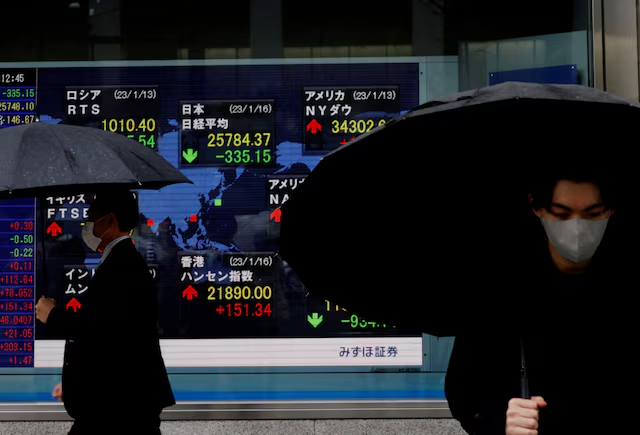
Asian stocks stumbled on Friday as investor confidence wavered amid political uncertainty in Japan and rising economic tensions between the U.S. and China. After recent strong gains, regional markets took a pause, with Hong Kong’s Hang Seng leading losses, down 1.8%, while Australia’s ASX 200 dipped 0.1%. Meanwhile, South Korea’s KOSPI bucked the trend with a 1.4% gain, extending its lead as one of Asia’s best-performing indices this year.
Japan’s market turbulence centered on doubts over the pro-market stance of the country’s prime minister-in-waiting, Sanae Takaichi. The Nikkei 225 fell 1%, while TOPIX dropped 1.9%, as investors reacted to Takaichi’s pledge to align monetary policy with government goals. Political uncertainty deepened after Japan’s Komeito party announced it would leave the ruling coalition, further complicating the policy landscape. Analysts warned that factors such as a lack of parliamentary majority and persistent inflation could limit her ability to pursue aggressive economic reforms akin to “Abenomics.”
Economic tensions in China added another layer of market pressure. The CSI 300 index fell 1.4% after Beijing expanded restrictions on rare-earth exports and strengthened chip import controls. These measures aim to reduce domestic reliance on U.S. technology and come ahead of ongoing high-level talks between Presidents Donald Trump and Xi Jinping. The moves raised concerns for global technology supply chains, particularly in AI hardware and semiconductors, affecting sentiment in markets across Asia.
Commodities markets saw mixed activity as investors paused after recent rallies. Gold slipped slightly to $3,970 per ounce following its historic break above $4,000, while silver retested the $50 mark. Oil prices eased, with Brent crude down 0.5% to $64.92 per barrel, after a ceasefire agreement between Israel and Hamas raised hopes for stability in the Middle East. Meanwhile, U.S. S&P futures showed modest gains, indicating cautious optimism ahead of the upcoming earnings season and expectations of a potential Federal Reserve rate cut later this month.
Despite the turbulence, analysts note that Asia’s regional markets remain on track for one of their best years in a decade. HSBC strategist Murat Ulgen highlighted that while investor sentiment has improved, overall market positioning remains light, suggesting that any recovery or sell-off could be swift. With political shifts in Japan and strategic trade restrictions in China, traders remain vigilant as the region navigates the delicate balance between economic opportunity and geopolitical uncertainty.
source: Reuters