
Tony Elumelu Urges Africa to Move From Foreign Aid to Investment and Trade

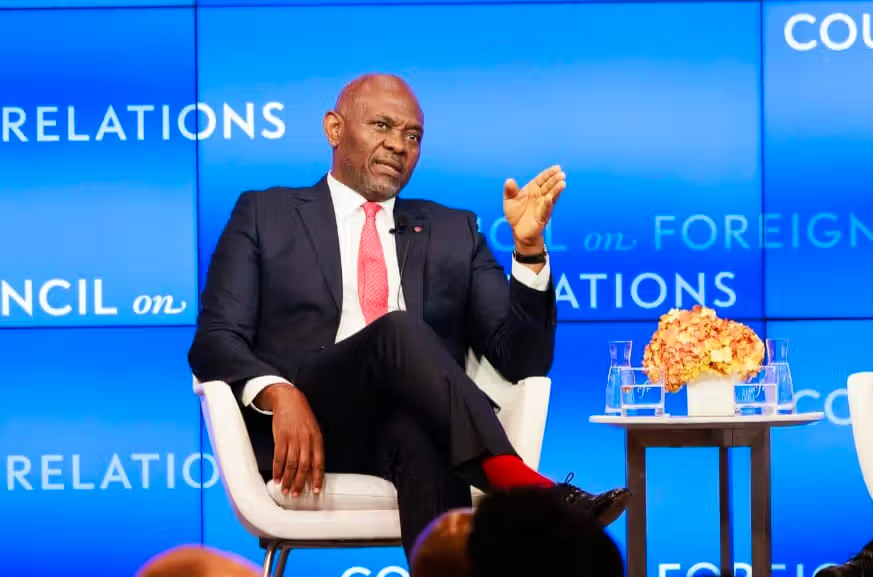
Tony Elumelu, chairman of Heirs Holdings, has called for a major shift in Africa’s economic development strategy, urging the continent to move beyond foreign aid and focus more strongly on investment, trade, entrepreneurship and private sector growth.
Speaking during a fireside chat held on the sidelines of the United Nations General Assembly (UNGA), Elumelu said Africa should increasingly take charge of its own economic transformation while encouraging global investors to view the continent as a commercial investment destination rather than an aid-dependent region. He also urged investors to look beyond broad perceptions of risk and consider the different economic opportunities across Africa’s 54 countries.
Elumelu said stronger partnerships between international investors and credible African businesses could help unlock capital for industries, infrastructure and trade. He reaffirmed his philosophy of Africapitalism, which places private-sector participation and domestic capital at the centre of Africa’s long-term economic development. According to him, while aid can provide immediate relief, sustainable industries require investment that can create lasting economic value and jobs.
The businessman also highlighted Africa’s young population, saying youth unemployment requires urgent attention. He pointed to the Tony Elumelu Foundation’s $100 million commitment to empowering young African entrepreneurs and said providing non-refundable seed capital of $5,000, combined with business training, could support job creation in both rural and urban communities. He further called on international philanthropies, development agencies and corporations to increase support for youth-led micro, small and medium-sized businesses.
On energy and trade, Elumelu argued that Africa needs reliable electricity to achieve industrial and digital growth, noting that more than 600 million Africans still lack access to electricity. He supported the use of Africa’s natural gas as a transition fuel while renewable energy infrastructure develops and called for stronger US-Africa trade partnerships, greater manufacturing capacity and fewer regulatory barriers. He also said the African Continental Free Trade Area (AfCFTA) could play an important role in strengthening supply chains and expanding intra-African commerce.
source: The cable