
Tinubu unveils plan to double Nigeria’s $32bn livestock economy, promotes ranching, dairy investment

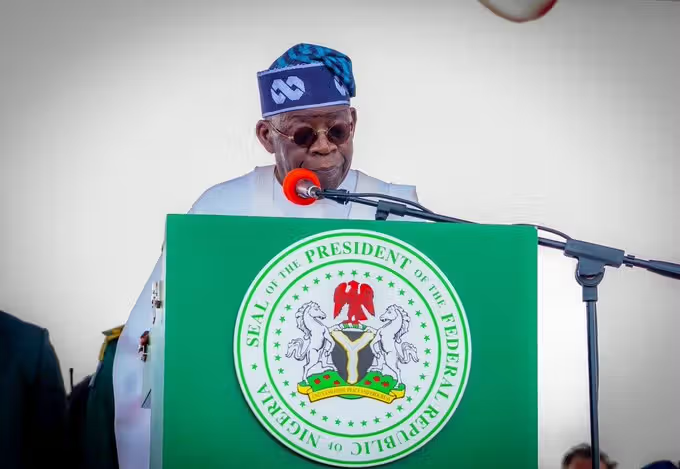
President Bola Tinubu has unveiled an ambitious plan to more than double Nigeria’s livestock economy from an estimated $32 billion to over $64 billion annually, as the Federal Government steps up efforts to modernise animal agriculture and attract fresh investment into the sector. The president announced the target on Monday in Abuja while opening the 9th All Africa Conference on Animal Agriculture, signalling a stronger push to turn livestock production into a major engine of economic growth.
Represented by Secretary to the Government of the Federation George Akume, Tinubu said Nigeria’s livestock industry must move beyond largely subsistence production and become a modern, commercially driven and globally competitive sector. The government plans to achieve this through reforms targeting better animal health services, improved livestock genetics, commercial feed production, stronger value chains and climate-smart farming practices. The administration also pointed to the creation of the Federal Ministry of Livestock Development in July 2024 as a key step in its livestock transformation agenda.
Ranching and dairy production are expected to play a major role in the strategy. Tinubu said the government wants to double local milk production by improving animal breeds, nutrition, breeding systems, pasture development and milk collection infrastructure while encouraging private investment in modern dairy processing. The administration is also promoting ranching and other modern livestock systems as part of efforts to increase productivity and create a more organised industry while reducing some of the tensions linked to traditional livestock production.
Beyond meat and milk, the government sees opportunities across the wider livestock value chain, including leather, feed milling, transportation, processing, technology, finance and exports. Tinubu said the sector could create millions of jobs, particularly for young Nigerians, while women and youth would be encouraged to participate through better access to finance, digital technology, innovation and private-sector partnerships. With Nigeria’s growing population and demand for food, the government believes a stronger livestock industry could also reduce dependence on imported dairy products and strengthen domestic food production.
The president also called for greater cooperation among African countries to tackle animal diseases, climate change, food insecurity, trade barriers and cross-border livestock movement. The five-day conference, which began on August 9 and ends on August 13 at the Shehu Musa Yar’Adua Centre in Abuja, is bringing together stakeholders to discuss animal health, climate-smart production, livestock genetics, research, innovation, investment and regional trade. For Nigeria, the message from the government is clear: livestock is no longer being treated simply as a traditional agricultural activity, but as a potential $64 billion industry capable of creating jobs, attracting investment and strengthening the country’s position in Africa’s food economy.
source: The cable