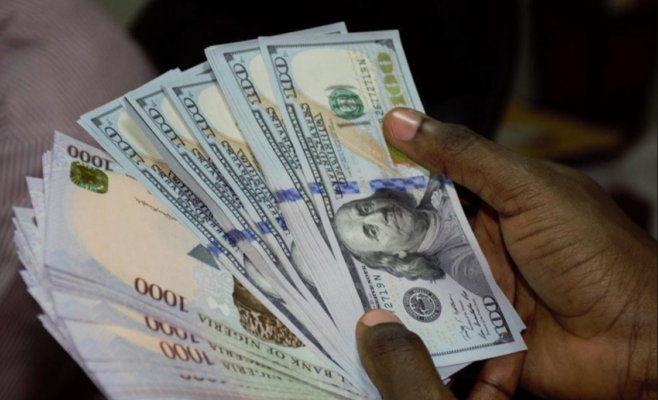
Nigeria’s naira held steady on Monday in the official foreign exchange (FX) market as the country’s external reserves surged to $46.7 billion, reaching a six-month high. The boost in reserves was largely driven by strong FX inflows and the federal government’s recent Eurobond issuance, signaling renewed confidence from international investors.
Data from the Central Bank of Nigeria (CBN) showed the naira depreciated marginally by 0.4 percent, trading at N1,448.03 against the dollar, compared with N1,442.43 on Friday. Meanwhile, the parallel market saw a slight appreciation, with the naira rising by N2 to close at N1,455, highlighting localized trading dynamics amid growing liquidity.
October 2025 marked the country’s strongest month for foreign exchange inflows since May, with total FX inflows jumping 91 percent month-on-month to $6.1 billion. Analysts attribute this surge to attractive carry-trade opportunities, high domestic interest rates, and improved macroeconomic stability, which together are drawing foreign investors back to Nigeria’s debt and currency markets.
The Eurobond market also reflected this investor optimism, with Nigeria’s $2.35 billion issuance oversubscribed by 400 percent. Global rating agencies are taking notice: S&P Global recently upgraded Nigeria’s outlook from “stable” to “positive,” affirming the country’s B-/B rating. Local participation in the FX market also strengthened, indicating growing retail engagement alongside international investor confidence.

Despite these gains, Foreign Direct Investment (FDI) fell 25 percent month-on-month to $222 million, revealing lingering structural challenges such as insecurity and policy uncertainty. Still, the combined effect of strong portfolio inflows, high yields, and a more stable naira suggests that Nigeria is increasingly viewed as an attractive destination for foreign investors seeking both short-term returns and macroeconomic resilience.
source: Business day