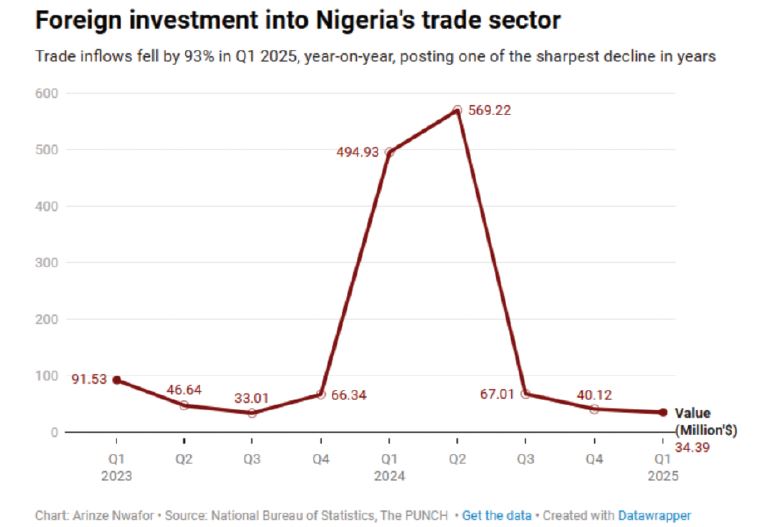
Foreign investment in Nigeria’s trade sector has taken a sharp hit, with capital inflows plummeting to $34.39 million in the first quarter of 2025, a staggering 93% drop compared to $494.93 million in the same period last year. Analysts say the decline reflects growing macroeconomic pressures, including exchange rate volatility, high inflation, and the government’s pivot toward local sourcing. Trade, long a pillar of Nigeria’s economy, contributed just 18.21% to the nation’s GDP in Q1 2025, down slightly from 18.45% a year earlier, signaling slower growth and reduced foreign appetite for the sector.
Experts highlight that the drop in trade investment is not a sign of lost confidence in Nigeria overall, but rather a reallocation of foreign capital to sectors better aligned with government priorities. Agriculture, banking, and select manufacturing segments have emerged as new destinations for foreign investment, reflecting Nigeria’s broader push to reduce import dependence and expand domestic production. Analysts caution, however, that the transition must be managed carefully to maintain a balance between local development and global integration.
Industry specialists point to currency instability and rising costs as key deterrents for foreign investors. Dr. Muda Yusuf, Director of the Centre for Promotion of Private Enterprise, explained that international retail chains and shopping malls face high import costs, fluctuating exchange rates, and prohibitive tariffs on certain goods, prompting exits or scaled-down operations. The rise of high-quality local supermarkets has also shifted consumer demand away from larger foreign-owned outlets, further affecting trade inflows.
Inflation and logistics challenges compound the pressure on retail investors. Prof. Uchenna Uzo, Director of the Africa Retail Academy, noted that higher import costs and reliance on debt for expansion have forced many operators to pivot toward locally sourced products. While this “Made-in-Nigeria” trend may constrain short-term foreign investment, experts argue it could strengthen the sector over time by encouraging self-reliance and improving supply chain resilience.

Economists emphasize that Nigeria’s policy shift toward local production is a strategic reallocation rather than a capital flight crisis. Prof. Segun Ajibola, former President of the Chartered Institute of Bankers of Nigeria, highlighted that while trade inflows have fallen, overall net capital importation into Nigeria has risen, particularly in agriculture and banking. Analysts stress that a balanced policy approach—stabilizing exchange rates, controlling inflation, and improving logistics—will be key to sustaining investor interest while promoting domestic growth.
Source: punch