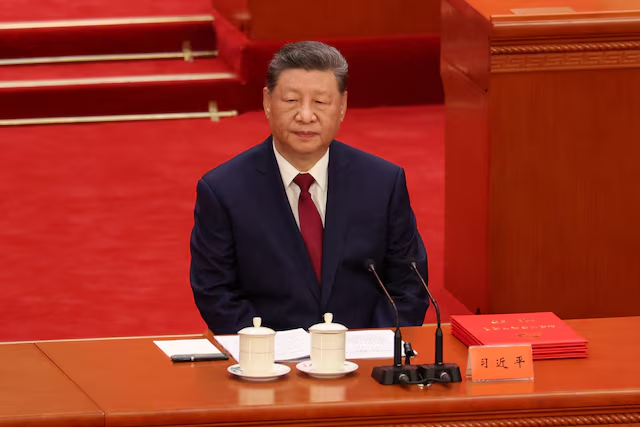
Chinese President Xi Jinping is expected to take center stage at the World Artificial Intelligence Conference (WAIC) in Shanghai this week, where he will present China’s vision for the future of global artificial intelligence governance. The event marks Xi’s first appearance at the annual conference and highlights how AI has become a major pillar of China’s economic ambitions and international strategy. As competition between China and the United States intensifies, Beijing is using the forum to position itself as a leading voice in shaping the rules and future direction of AI worldwide.
One of the biggest attractions at the conference will be Huawei’s unveiling of the Atlas 950 SuperPoD, its most advanced AI computing cluster to date. Designed to handle large-scale AI training and data processing, the system links thousands of Huawei Ascend processors into a single powerful network. The launch is being viewed as a significant milestone for China’s technology sector, demonstrating the country’s determination to develop cutting-edge AI infrastructure despite ongoing restrictions on access to advanced U.S. semiconductor technology.
China’s growing confidence in its domestic AI ecosystem is also being reflected in the progress of local companies. DeepSeek’s latest V4 AI model has reportedly been adapted to run entirely on Huawei’s Ascend chips, reducing dependence on foreign technology. Several Chinese chipmakers, including Biren and MetaX, are also expected to introduce new high-performance computing systems during the event, showcasing the rapid pace of innovation taking place within China’s AI industry.
Beyond technological advancements, the conference is expected to serve as an important diplomatic platform. With Washington and Beijing preparing for their first government-level AI discussions under U.S. President Donald Trump’s administration, WAIC has become more than just a technology exhibition. China is expected to promote its open-source AI models as affordable and accessible alternatives to Western systems, arguing that broader access to AI can help reduce global technological inequality and support developing nations.

The Shanghai gathering will attract a high-profile international audience, including United Nations Secretary-General António Guterres, Kazakhstan President Kassym-Jomart Tokayev, and Thailand’s Prime Minister Anutin Charnvirakul. AI pioneers and award-winning researchers are also expected to participate, reinforcing the conference’s growing global influence. As China pushes forward with plans such as the proposed World AI Cooperation Organisation (WAICO), the event is shaping up to be a defining moment in Beijing’s effort to strengthen its position as a global leader in artificial intelligence and digital diplomacy.
source: reuters