
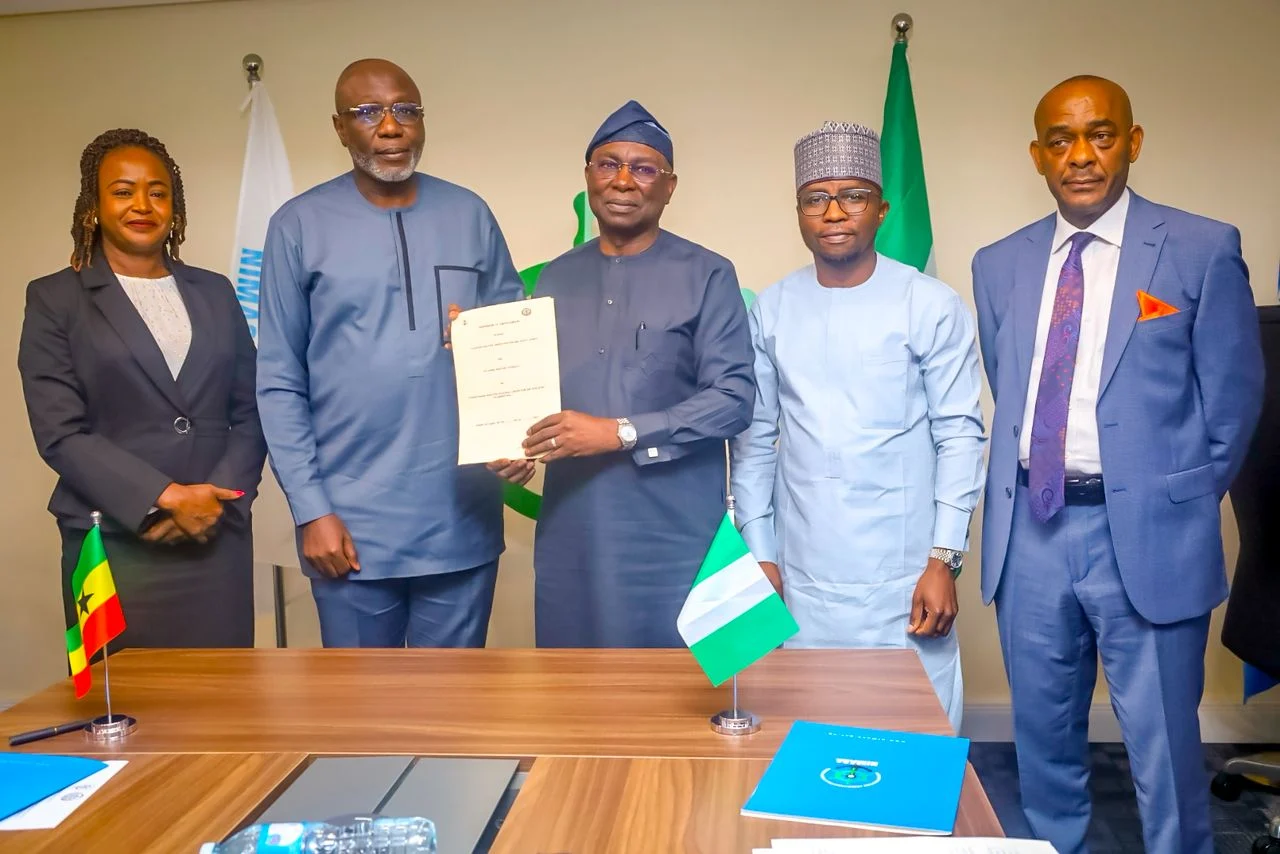
Nigeria and Ghana have taken a major step toward strengthening maritime ties after signing a new Memorandum of Understanding (MoU) designed to deepen cooperation in the maritime sector and unlock greater economic opportunities across West Africa. The agreement, signed by the Nigerian Maritime Administration and Safety Agency (NIMASA) and the Ghana Maritime Authority (GMA), is expected to enhance maritime governance, improve security, and accelerate the growth of the region’s Blue Economy.
Speaking at the signing ceremony in Lagos, the Director-General of NIMASA, Dr. Dayo Mobereola, praised Ghana for its support during Nigeria’s successful re-election to the International Maritime Organisation (IMO) Category C Council. He noted that the long-standing relationship between both countries has continued to strengthen maritime development in the region and described the new agreement as a practical roadmap for deeper collaboration in maritime safety, security, capacity building, knowledge sharing, and joint enforcement initiatives.
Mobereola stressed that the success of the partnership would depend on measurable actions rather than promises alone. According to him, both countries must establish annual implementation plans to track progress and ensure the agreement delivers tangible benefits. He emphasized that Nigeria and Ghana, as two of West Africa’s leading maritime nations, share a responsibility to drive innovation, economic growth, and sustainable maritime development throughout the region.
On his part, the Director-General of the Ghana Maritime Authority, Dr. Kamal-Deen Ali, described the agreement as a significant milestone that further strengthens an already productive relationship between the two nations. He acknowledged Nigeria’s leadership in the maritime sector, noting that Ghana has benefited from studying and adapting lessons from Nigeria’s cabotage system, ship registry operations, and maritime regulatory frameworks. He reaffirmed Ghana’s commitment to fully implementing the agreement and expanding cooperation for mutual growth.

Beyond strengthening bilateral relations, the partnership is expected to have far-reaching benefits for the entire Gulf of Guinea. Both maritime agencies will establish a Joint Consultative Team that will meet twice yearly to oversee implementation, evaluate progress, and coordinate future initiatives. Industry stakeholders believe the alliance will improve maritime governance, strengthen institutional capacity, promote research-driven policymaking, and enhance efforts to combat piracy, armed robbery at sea, and maritime terrorism, positioning West Africa for safer waters and stronger economic growth.
source: punch


