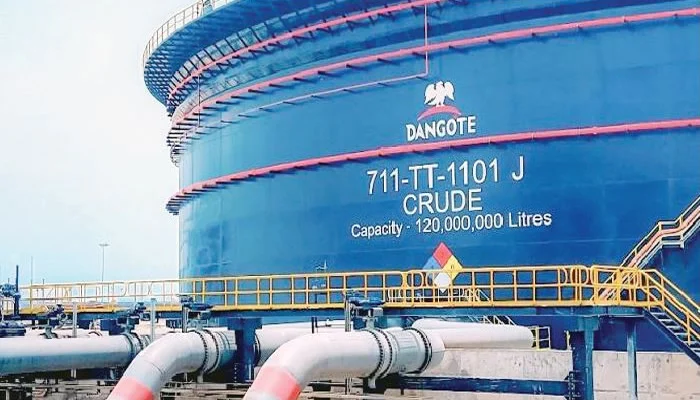
Dangote Refinery has hit a major milestone, producing 50 million litres of Premium Motor Spirit (PMS) daily, supported by a 24-hour truck loading operation moving over 1,000 trucks each day. The refinery’s Managing Director and CEO, David Bird, emphasized that this achievement reflects both production capacity and efficient distribution, helping to eliminate the fuel scarcity that has plagued Nigerian cities during peak periods.
Bird revealed that the refinery could expand to 1.4 million barrels per day within three years, using a “roofless replication” strategy to duplicate the current design without costly delays. This approach avoids the extensive reengineering that often slows large-scale energy projects, allowing the refinery to fast-track procurement and construction while maintaining proven operational efficiency.
Highlighting the refinery’s modern design as a “merchant refining, blending and trading platform,” Bird explained that even during planned maintenance, the facility continues to meet domestic fuel demand. The round-the-clock operations, he said, are central to Nigeria’s fuel price stability and ensure consistent offtake, with more than 1,000 trucks delivering daily across the country.
Beyond fuel, Dangote Refinery is positioning itself in the petrochemicals sector, with polypropylene production as a key focus. Bird outlined plans to diversify into detergents, base oils, lubricants, and LPG, driven by import substitution and rising domestic demand. He also noted that 30–40% of the refinery’s crude supply comes from the government’s crude-for-naira program, signaling ongoing collaboration with the Nigerian National Petroleum Company Limited (NNPCL).

Located in the Lekki Free Trade Zone, Dangote Refinery is already the world’s largest single-train refinery with a 650,000-barrel daily capacity. The proposed expansion to 1.4 million barrels per day would cement its position as a global energy hub and reshape fuel flows in Africa, reducing dependence on imported refined products. Bird reassured Nigerians that the refinery’s growth will support stable fuel prices and strengthen energy security nationwide.
source: The Guardian