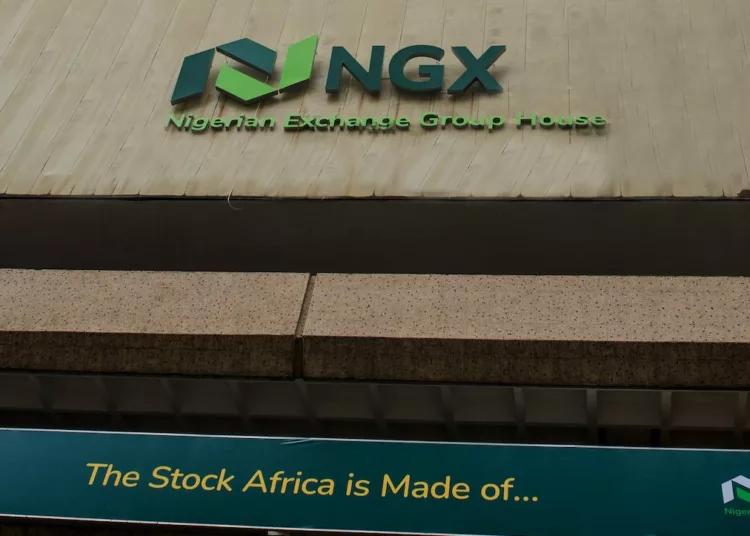
Nigeria’s stock market witnessed significant activity in the first 11 months of 2025, with ten leading stockbroking firms facilitating trades worth a combined N6.6 trillion on the Nigerian Exchange (NGX). According to a broker performance report released by NGX, these firms accounted for 62.57% of the total market transactions, highlighting their dominant role in the country’s capital market.
The top five brokerage firms driving this growth were Cardinalstone Securities, Chapel Hill Denham Securities, Stanbic IBTC Stockbrokers, First Securities Brokers, and Cordros Securities. Cardinalstone led the pack, handling N2.05 trillion or 19.39% of total trades, while Chapel Hill Denham recorded N962.2 billion, representing 9.11% of transactions. Stanbic IBTC Stockbrokers facilitated trades worth N690.24 billion, followed by First Securities with N616.44 billion and Cordros with N571.7 billion.
Other firms on the top ten list included EFG Hermes, Meristem Stockbrokers, APT Securities & Funds, United Capital Securities, and CSL Stockbrokers. EFG Hermes traded stocks valued at N436.18 billion, Meristem handled N427.75 billion, and APT Securities recorded N341.56 billion. United Capital and CSL Stockbrokers facilitated N279.94 billion and N232.96 billion, respectively, contributing to the strong overall market turnover.
By volume, Chapel Hill Denham Securities led with $43.5 billion, or 11.14% of the $191.56 billion traded on the NGX, with Cardinalstone following closely at $37.6 billion, representing 9.64% of total volume. Analysts noted that a significant portion of these transactions came from Foreign Portfolio Investors (FPIs), domestic institutional investors, and collective investment schemes, reflecting both domestic and international confidence in Nigeria’s equities market.

Market observers say the performance of these top brokers underscores the growing sophistication of Nigeria’s capital markets, where large-scale trades are increasingly driven by both foreign inflows and structured investment funds. As these firms continue to dominate trading activity, the trend highlights Nigeria’s potential as a leading investment destination in Africa’s financial landscape.
source: leadership