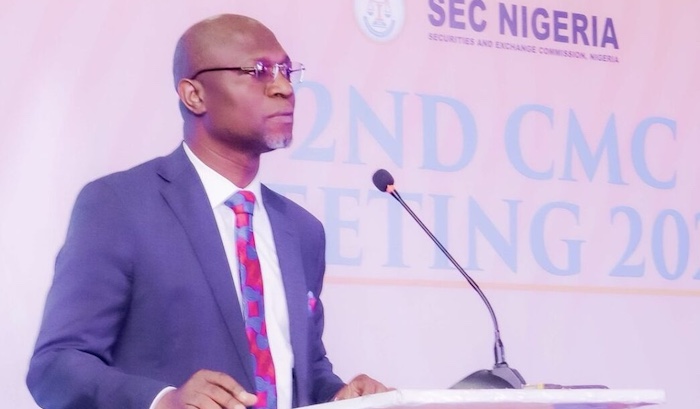
Director-General of the Securities and Exchange Commission (SEC), Dr. Emomotimi Agama, has expressed deep concern over Nigerians’ preference for gambling over investment. Speaking at the annual conference of the Chartered Institute of Stockbrokers, Agama revealed that while fewer than three million Nigerians currently invest in the capital market, more than 60 million engage in gambling activities every day — spending an estimated $5.5 million daily. He described the situation as a paradox, noting that “a risk appetite clearly exists, but not the trust or access to channel that energy into productive investment.”
Agama highlighted that over $50 billion worth of cryptocurrency transactions flowed through Nigeria between July 2023 and June 2024, reflecting the sophistication and risk tolerance of Nigerians. However, he lamented that the traditional capital market has failed to capture this dynamic investor class. With fewer than 4% of adults participating in capital market activities, Agama warned that this low rate of inclusion poses a serious challenge to capital formation and economic growth.
The SEC boss also drew attention to the country’s weak market capitalisation-to-GDP ratio, currently around 30%, compared to 320% in South Africa, 123% in Malaysia, and 92% in India. He said the disparity underscores the urgent need to deepen financial inclusion, build investor confidence, and strengthen the capital market as a tool for economic transformation. “Our market must evolve beyond concentration in a few large-cap stocks like Airtel Africa, Dangote Cement, and MTN Nigeria,” he said.
Reflecting on the Capital Market Master Plan (CMMP) 2015–2025, Agama said the 10-year roadmap aimed to make the capital market the engine of Nigeria’s economic transformation. However, only about half of the 108 initiatives outlined in the plan were fully achieved. He attributed the shortfall to weak alignment with national development plans, poor stakeholder engagement, and inadequate performance tracking. Still, he noted progress in areas such as green bonds, fintech integration, Sukuk, and non-interest finance.

Looking ahead, Agama outlined six key challenges that must shape the next phase of reforms: low retail participation, market concentration, declining foreign inflows, underutilised pension assets, untapped diaspora capital, and a widening infrastructure financing gap. He called for a “reimagined SEC” that acts not only as a regulator but as an enabler of private-sector-led growth. “Vision without execution is inertia, and reform without measurement is aspiration without accountability,” he concluded.
source: Arise