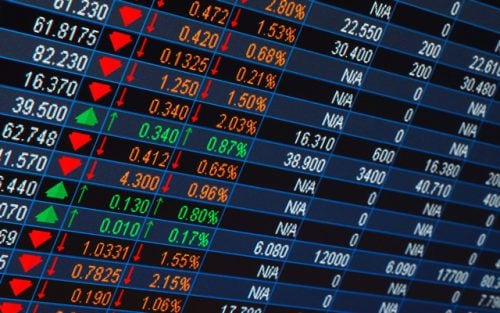
European markets opened lower on Tuesday, wiping out the week’s early optimism as renewed trade tensions between the United States and China rattled investor confidence. The pan-European Stoxx 600 fell 0.8%, with most major indices in negative territory. France’s CAC 40 dropped 0.76%, Germany’s DAX slipped 0.93%, and Italy’s FTSE MIB declined 0.96%. The market pullback came as traders reassessed global growth risks and corporate outlooks under the shadow of escalating tariff threats.
Investor sentiment weakened after U.S. President Donald Trump hinted at a new round of tariffs on China in response to Beijing’s fresh export restrictions on rare earth minerals — critical components for industries such as defense, semiconductors, and electric vehicles. China currently dominates about 70% of the world’s supply of these minerals, raising fears of a global supply bottleneck. Although Trump later softened his stance in a Truth Social post, assuring that trade relations “will all be fine,” the brief reassurance did little to calm market nerves.
French tire giant Michelin saw its shares tumble nearly 10%, after the company slashed its full-year forecast, blaming a “deteriorating business environment.” The company reported weaker performance in North America, where tariffs and a softer U.S. dollar hurt competitiveness. Analysts at Deutsche Bank responded by cutting their target price for Michelin by 16%, calling the outlook downgrade “sharper than expected.” In contrast, Sweden’s Ericsson offered a rare bright spot — its shares surged 13% after posting a 191% year-on-year jump in net income, buoyed by robust growth in its cloud and network divisions.
Across sectors, mining and defense stocks bore the brunt of the selloff. The Stoxx Basic Resources Index slid 2.2%, while the Aerospace and Defense Index dropped 1.5% amid concerns over rare earth shortages impacting defense production. Notable decliners included Germany’s Renk (-2.6%), Italy’s Leonardo (-1.7%), and Sweden’s Saab (-1.7%). Meanwhile, the British pound fell 0.5% against both the dollar and the euro following data showing a rise in the U.K.’s unemployment rate to 4.8%, slightly above forecasts.

Attention now turns to the IMF and World Bank annual meetings in Washington, where policymakers and financial leaders will address global economic stability, inflation, and trade risks. The IMF’s latest World Economic Outlook is expected to offer insights into the impact of rising geopolitical tensions and slowing growth. For now, European investors remain cautious, with sentiment clouded by uncertainty over global trade and monetary policy — and by the reminder that market optimism can evaporate as quickly as it appears.
Source: cnbc