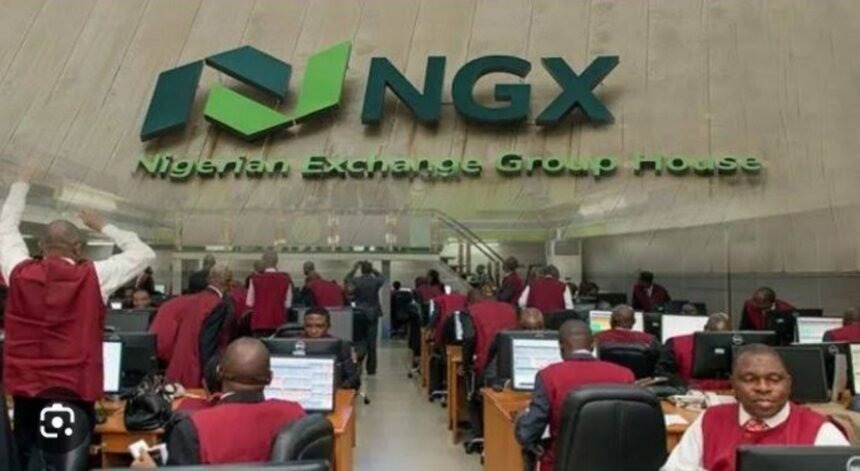
The Nigerian Exchange (NGX) closed the week ended August 15, 2025, in negative territory as the equities market shed N713 billion in market value. The All-Share Index (ASI) slipped by 0.77 per cent week-on-week to 144,628.20 points, while market capitalisation dropped to N91.50 trillion. This downturn trimmed the market’s year-to-date return to 40.52 per cent, with analysts attributing the decline to weak sentiment and widespread selloffs across key sectors.
The decline was largely driven by losses in Banking, Consumer Goods, Industrial Goods, Oil & Gas, and Commodities, while the Insurance Index emerged as the best-performing sector, rising 8.21 per cent on renewed investor confidence after the signing of the Nigerian Insurance Act into law. Other gainers included the NGX AFR Dividend Yield Index (+1.57%) and the NGX Growth Index (+9.50%), which reflected selective bargain-hunting in growth-focused equities.
Trading activity also weakened during the week, with investors transacting 8.56 billion shares worth N99.94 billion in 177,870 deals, compared with 8.73 billion shares valued at N134.58 billion in 180,290 deals recorded the previous week. The Financial Services sector maintained dominance, accounting for over 80 per cent of total trade volume and 56.75 per cent of market value, while Oil & Gas and Agriculture followed as the most active industries.
In terms of stock performance, Universal Insurance, Linkage Assurance, and AIICO Insurance led the market in volume, contributing more than 32 per cent of total turnover. Top gainers included Mutual Benefits Assurance (+31.85%), Triple Gee (+30.23%), and SUNU Assurance (+23.80%), while UPDC (-17.72%), LivingTrust Mortgage Bank (-16.00%), and Berger Paints (-14.67%) led the losers’ chart. Meanwhile, bond turnover rose to 102,338 units worth N101.28 million, even as Exchange Traded Products (ETPs) fell sharply to 216,055 units valued at N27.02 million.

Looking ahead, analysts at Cowry Asset Management cautioned that weak investor sentiment could persist in the near term, as portfolio reshuffling and sector rotation continue to shape market dynamics. They noted that despite Nigeria’s inflation easing to 21.88 per cent in July—its fourth consecutive monthly decline—investors are expected to adopt a cautious approach, balancing profit-taking with bargain-hunting opportunities driven by naira stability, improved FX liquidity, and softer global commodity prices.
Source: The Sun