
Japan’s Political Turmoil Threatens Budget Process and Delays in BOJ Rate Hike

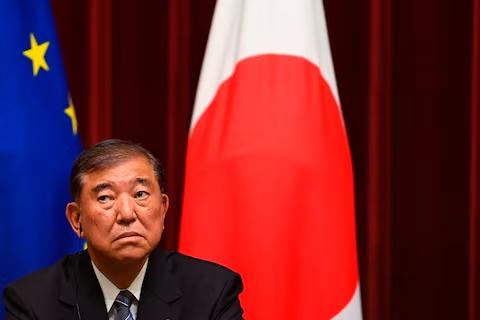
Japan is facing mounting political uncertainty as Prime Minister Shigeru Ishiba comes under intense pressure from his own Liberal Democratic Party (LDP) to resign after a series of election defeats. The turmoil risks stalling policy decisions critical to drafting next year’s budget and could delay the Bank of Japan’s (BOJ) next interest rate hike. Analysts warn that prolonged instability could cloud economic prospects at a time when Japan is already grappling with the impact of U.S. tariffs and a fragile recovery.
In a rare move, LDP lawmakers are debating whether to hold a leadership race while the incumbent party head remains in office. Under party rules, such a contest can only proceed with majority backing from lawmakers and regional leaders. If scheduled in September, a new administration could still compile an economic stimulus package before year-end. However, if delayed, the leadership race may be pushed into early 2026 to avoid disrupting the government’s budget drafting process.
Japan’s Ministry of Finance typically collects spending requests in August and finalizes the draft budget in December, ahead of the April fiscal year start. Failure to pass the budget in time could force the government to operate on a stop-gap measure, delaying expenditure and hurting economic momentum. With the ruling coalition having lost control of both parliamentary houses, passing legislation now requires opposition cooperation — which many parties refuse to grant unless Ishiba steps down.
The political deadlock also complicates the BOJ’s monetary policy decisions. While markets do not expect a rate hike in September, some analysts see possible action later in the year or early 2026, depending on the economic impact of U.S. tariffs. Ishiba, a fiscal hawk, supports gradual tightening, but his weakened position increases pressure for higher government spending and looser monetary policy — a stance favored by opposition parties and some LDP figures.
Potential leadership contenders, such as Sanae Takaichi, have openly opposed interest rate hikes, raising concerns that political debates could sway central bank policy. BOJ Governor Kazuo Ueda has emphasized a cautious approach, insisting that the bank will act only to sustainably meet its 2% inflation target. With political developments highly unpredictable, analysts believe the BOJ may opt to “wait and see” to avoid being drawn into partisan disputes.
Source: Reuters