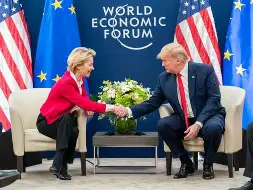
In high stakes move that prevented a looming transatlantic trade war, the U.S. and European Union reached a framework deal to impose a 15% tariff on most EU imports, half the initially threatened 30%. Announced after a meeting between President Donald Trump and European Commission President Ursula von der Leyen at Trump’s Turn berry golf resort in Scotland, the agreement includes $600 billion in EU investment into the U.S. and significant increases in EU purchases of American energy and defense equipment. Trump called the pact “the biggest deal ever made,” positioning it as a win for U.S. exporters who have long faced trade imbalances with Europe.
The agreement mirrors key elements of a similar U.S.-Japan framework signed the week prior, though it leaves some critical issues unresolved, including specific tariff rates on spirits. EU leaders welcomed the deal, particularly Germany, whose major auto industry would have faced a 27.5% tariff without it. Still, many in Europe view the 15% rate as a tough pill to swallow, falling short of their original aim for tariff-free trade. The deal also outlines that the U.S. will maintain its 50% tariff on steel and aluminum, although a shift to a quota-based system may be negotiated in the future.
Although framed as a major success by Trump, who continues his push to reset global trade dynamics, the deal remains largely a political framework lacking detailed implementation. EU officials noted that while sectors like aircraft parts, generic drugs, semiconductor equipment, and select agricultural goods are exempt from tariffs, many areas, especially non-tariff barriers and regulatory standards—are still under discussion. Analysts warn that the agreement’s vagueness opens the door for misinterpretation and friction, just as seen with the recent U.S.-Japan pact.
Economically, the euro ticked up slightly following the announcement, reflecting short-term investor optimism. However, critics on both sides argue the deal favors U.S. interests disproportionately. Some EU parliamentarians warned that the enormous EU investment into the U.S. could come at the expense of domestic growth. Trump retains the power to increase tariffs if investment pledges aren’t met, fueling concerns over long-term stability. As with past U.S. trade deals, this agreement adds another notch to Trump’s “America First” trade legacy, but its effectiveness will be judged only when the fine print is finalized.

Source: Reuters