


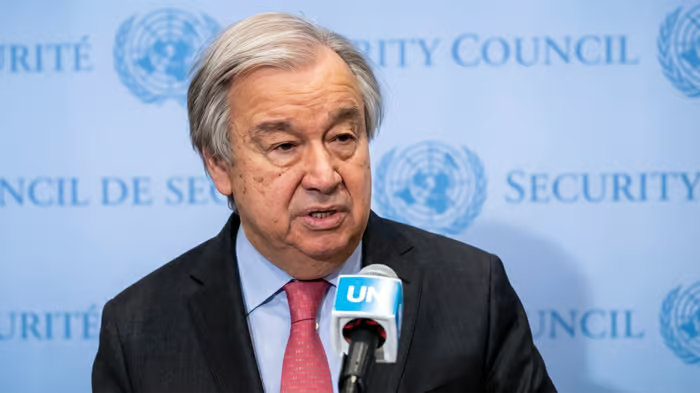
As the world observed International Clean Energy Day, United Nations Secretary-General António Guterres delivered a stark message: the global shift to clean energy is underway but far too slow. While renewable sources like wind and solar generated more electricity than coal for the first time in 2024, Guterres warned that the planet is still at risk of temporarily surpassing the critical 1.5°C temperature threshold. He emphasized that the challenge today is containment—ensuring the overshoot is “as small, as short and as safe as possible” through a fair transition from fossil fuels.
Renewable energy is increasingly seen as a solution not just for emissions, but also for energy security, lower costs, and resilience against geopolitical disruptions. However, the global picture remains uneven. Over 2.1 billion people still rely on firewood and charcoal for cooking, exposing households to deadly indoor pollution while worsening deforestation. The gap between clean energy potential and actual access is especially pronounced in sub-Saharan Africa, where unreliable electricity limits education, healthcare, and economic opportunity.
The economic benefits of clean energy are also unevenly distributed. A joint IRENA-ILO report shows global renewable energy employment grew modestly to 16.6 million jobs in 2024. Yet Africa captures only a tiny fraction of this growth, while countries like China dominate manufacturing and employment in solar and wind industries. Without targeted policies, the clean energy transition risks replicating old patterns of resource extraction, benefiting others while leaving Africa largely on the sidelines.
In Nigeria, the challenges are acute. Chronic grid failures and reliance on diesel generators make a rapid “net zero” shift unrealistic. Experts, including energy economist Prof. Wumi Iledare, argue for a gradual, balanced transition that reduces emissions while improving efficiency across the energy sector. The emphasis is on building resilient systems—modern grids, energy storage, and regional planning—rather than just adding renewable capacity. Multilateral support and concessional finance are key to unlocking Nigeria’s renewable potential and avoiding the pitfalls of high-risk projects.

The clean energy transition is increasingly recognized as both a political and social challenge. UNECE highlights the importance of managing trade-offs between energy, land use, water, and biodiversity. Guterres stressed justice, worker protection, and industrial development, noting that transitions fail when communities are left behind. For Nigeria and much of Africa, the lesson is clear: achieving clean energy success requires coordinated policy, investment, and planning that put people at the center of the shift.
source: The Guardian