

NNPC, Sahara Group Unveil Nigeria’s First Fully-Owned Floating Oil Vessel — A Milestone for Energy Independence

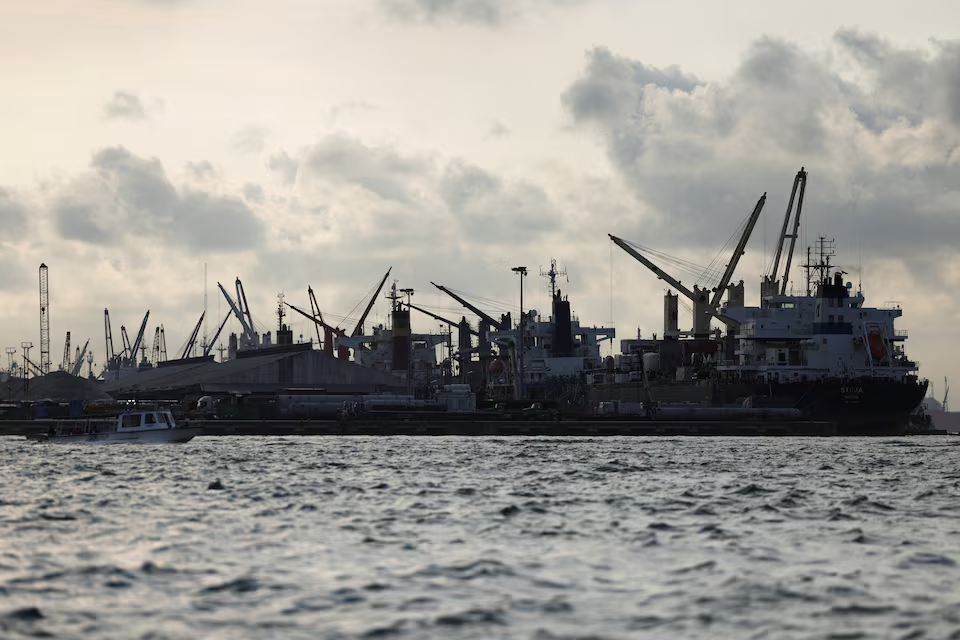
In a historic leap for Nigeria’s oil and gas industry, the Nigerian National Petroleum Company Limited (NNPC Ltd), Sahara Group, Eroton E&P, and Bilton Energy Ltd have unveiled the country’s first wholly owned Floating Storage and Offloading (FSO) vessel. The facility, christened FSO Cawthorne, boasts a massive 2.2 million-barrel capacity and marks Nigeria’s first new crude oil terminal in 50 years. The launch signals a bold move to strengthen the nation’s energy independence and oil export capacity.
According to NNPC’s Executive Vice President, Udobong Ntia, who represented Group CEO Bayo Ojulari, the Cawthorne vessel represents a “bold achievement” that aligns with President Bola Tinubu’s strategic vision to optimize upstream oil production. Strategically stationed offshore Bonny, the double-hull vessel will serve as a crucial hub for crude evacuation from OML 18 and surrounding fields — a development expected to improve operational efficiency and reduce export bottlenecks that have plagued the sector for decades.
Designed with state-of-the-art technology, the Cawthorne FSO combines digital automation, artificial intelligence, and advanced marine control systems to ensure safe, efficient, and environmentally responsible operations. The vessel will receive, store, and offload crude oil directly to export tankers, eliminating dependence on aging pipelines and risky ship-to-ship transfers. It can host up to 50 personnel onboard, offering a modern and secure environment for operations and maintenance crews.
Tosin Etomi, Head of Commercial and Planning at Asharami Energy (a Sahara Group upstream company), described the vessel as “a symbol of innovation meeting necessity.” Etomi emphasized that the project was driven by the need to reduce logistical constraints, improve safety, and create sustainable solutions for Nigeria’s crude evacuation system. “This is not just a vessel; it’s an assurance of continuity, reliability, and value creation for our partners and the nation,” he said.

The FSO Cawthorne project was conceived to tackle long-standing challenges such as limited barging capacity, delays in crude transfers, and restricted vessel accessibility caused by siltation. Converted from a Very Large Crude Carrier (VLCC) into a fully integrated FSO, the project meets international safety and environmental standards (IMO and MARPOL). Beyond its immediate benefits, the vessel is scalable to accommodate future production increases, reinforcing its position as a strategic national asset and a testament to Nigeria’s growing engineering and energy expertise.
source: punch